
// MOLD REMEDIATION · MOLD ASSESSMENT
Mold Assessment
Identify the conditions. Document the source. Define the scope.
QUICK ANSWER
A mold assessment is a documented inspection that identifies conditions indicating mold growth, the moisture source supporting it, and the scope of affected materials. It produces an independent, documented basis for any remediation work — rather than a guess — and separates understanding the problem from addressing it.
// RELATED SERVICES
Scope of Work
SERVICE INVENTORY
- MOLD ASSESSMENT
- VISUAL INSPECTION
- MOISTURE INVESTIGATION
- THERMAL IMAGING
- AFFECTED MATERIAL DOCUMENTATION
- SCOPE OF WORK
- MOISTURE SOURCE IDENTIFICATION
- CONDITION DOCUMENTATION
// ANSWER-FIRST CONTENT
Common Questions, Direct Answers
What is a mold assessment?
A mold assessment is a documented inspection that identifies conditions indicating mold growth, the moisture source supporting it, and the scope of affected materials. The assessment produces a documented basis for remediation — defining what is happening, where, and why — before any physical work begins.
Why is assessment separate from remediation?
Assessment determines what is happening and why — the location, extent, and moisture source. Remediation is the physical work of removing the contamination. Separating the two provides an independent, documented basis for the remediation scope and for post-remediation verification, rather than a remediator grading their own work.
What does a mold assessment include?
A visual inspection of accessible areas, moisture readings to identify the source, documentation of visible conditions and affected materials, and a written scope of work for remediation. The assessment documents conditions — it does not diagnose health issues or guarantee the absence of hidden mold behind inaccessible surfaces.
How is the moisture source identified?
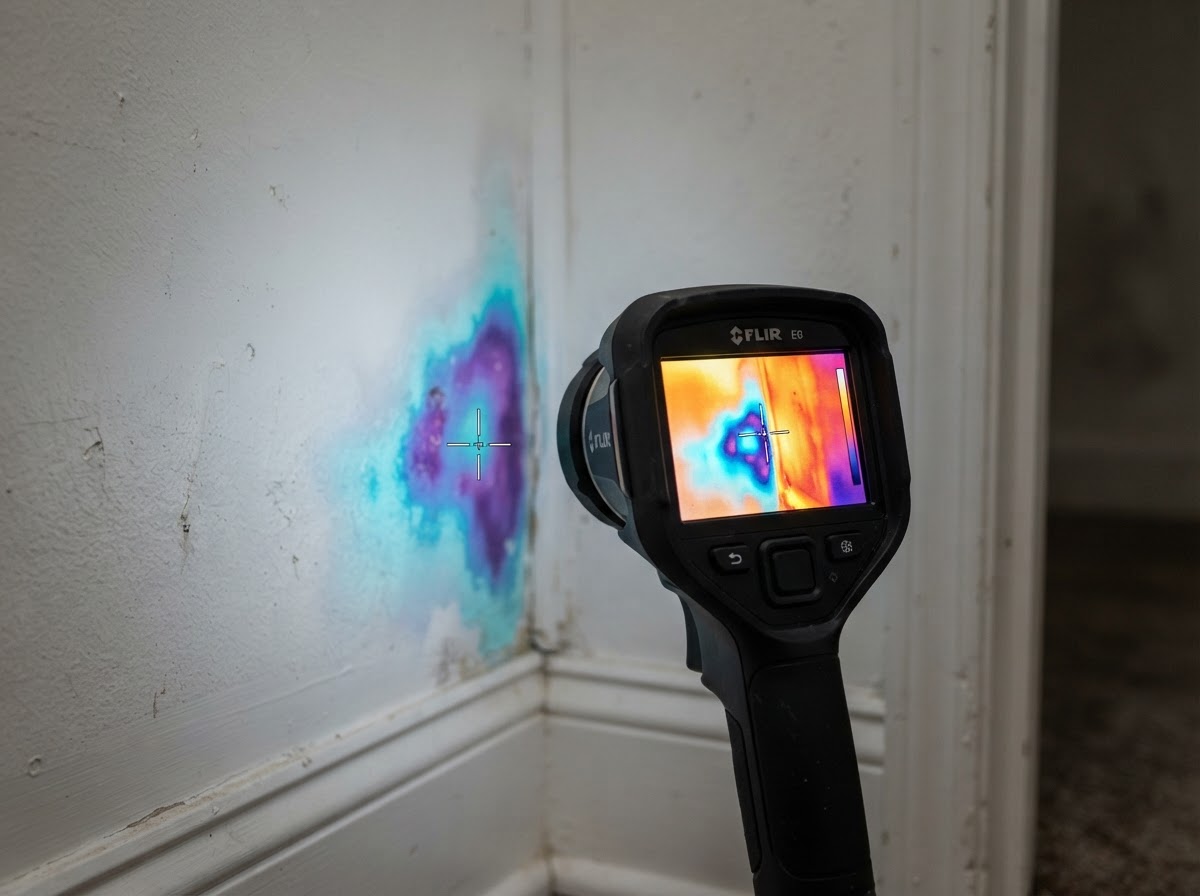
A technician uses moisture meters, thermal imaging, and thermo-hygrometers to locate elevated moisture in building materials and track it to its source — a leak, condensation, humidity, or water intrusion. Documenting the moisture source is essential because mold will typically return if the source is not corrected.
Can a mold assessment find hidden mold?
An assessment can identify conditions that suggest hidden mold — elevated moisture behind walls, under flooring, or in cavities — using moisture meters and thermal imaging. It cannot confirm mold behind inaccessible surfaces without opening those areas, but it documents the conditions that warrant further investigation.
What happens after a mold assessment?
The assessment produces a documented scope of work that a remediation team follows. The scope defines the affected areas, the containment required, the materials to be removed or cleaned, and the clearance criteria. Assessment and remediation may be performed by different parties to maintain independence.
How long does a mold assessment take?
The time depends on the size of the property and the complexity of the conditions. A typical residential assessment takes one to several hours on site, followed by a written report. The assessment documents conditions at a point in time and does not include laboratory analysis unless specifically requested.
Is a mold assessment the same as a mold test?
No. An assessment is a documented visual and moisture-based inspection that identifies conditions and scope. Mold testing — air sampling or surface sampling — is a separate service that may be used in specific situations but is not always necessary to define a remediation scope. An assessment focuses on conditions and moisture, not laboratory results.
// RELATED TOPICS & RESOURCES
// CREW RESTORATION
Request a Mold Assessment Assessment
Identify the conditions. Document the source. Define the scope.
(813) 838-5961